
I’m finally jumping back into the Yarn Along with Ginny. I’ve actually gotten to knit and read again, so it’s good to do.
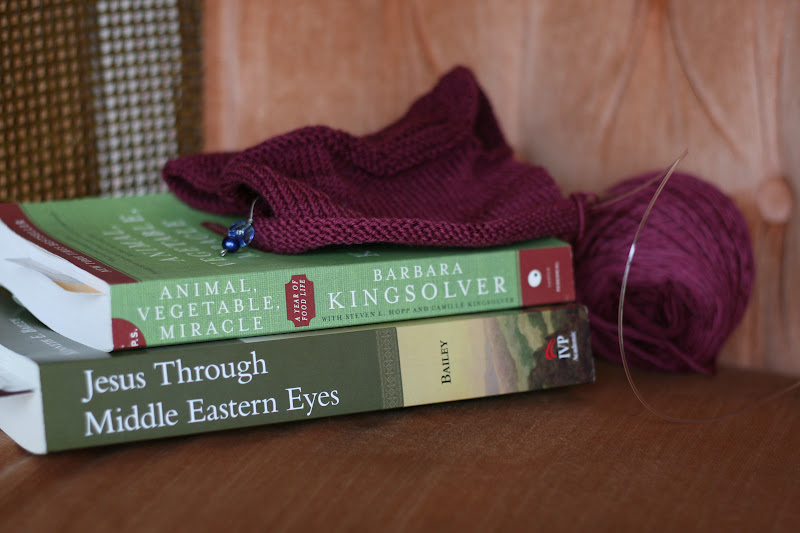
For knitting I’m just finishing up a little sample of my “Little Pearl Vest” pattern that was requested for display at my local yarn store. They’re selling my pattern, and were wondering if I could knit up a quick display with some of their yarn. Since it was them, and I love them, I said yes. I have realized since, that it is no fun to make baby clothes that will never be worn by a baby. The nostalgia is just not there. Anyway, it was quick and is now done.
I’ve been going between 2 books for reading. The first is one I ordered awhile back that was recommended to me by several people: Animal, Vegetable, Miracle
So far I love the book. Already I learned more about growing asparagus better, and things like that are most of the reason this book was recommended to me. There’s so much good information and recipes along the way in there. The most popular recipe among my friends is the “30 minute homemade mozzarella” that she has in there. I haven’t gotten to that part yet.
There’s a lot in the book that I think are great. I find it a bit funny that the author and I come from completely different world views, but I would come to very many of the same conclusions as her. The information that she gives on the quality of food, and her passion for Americans to be aware of what they’re eating is contagious.
There are a few uncomfortable moments where I feel like I’m in an awkward conversation with the author. Are you ever talking with someone and they start ripping apart “a certain kind of people,” not realizing that you’re one of those people. I’ve heard people say “Well, I think it’s great that you homeschool, because it’s not like you’re one of these kinds of homeschoolers that I despise.” I never know how to respond to digs like that because it’s like sideways gossip. I have friends who are those kinds of homeschoolers, and often I am that kind of homeschooler.
It’s not just about homeschooling, and she never talks about it in the book. That’s just my example. The topic of this author’s favorite dig is “those stupid people who don’t believe in evolution.” Although I LOVE what this author says about food and culture, and is someone I would enjoy hanging out with, she drops these “digs” all the time towards anyone who would question evolution.
What I find so funny is that all of her digs are so misguided (as they are with all of us who have prejudices…and we all do) and refer to parts of science that refer to natural selection. She points as natural selection (which I think most Christians would fully agree with Darwin) and says, “people who don’t believe this are stupid.” Well, yes, natural selection is great science. No argument there. I just don’t believe my ancestors were monkeys, which she refers to a few times as well. Since I believe that corn can be modified to become more suited to each individual climate, I must therefore believe that we evolved from goo, and if I don’t believe that connection, something is wrong with my brain according to this author. (This author ironically never claims that corn modifies itself into beets, or beans, or tomatoes. It always stays corn. That’s the science I see.)
However, she says several things that are really inspirational and have really gotten stuck in my brain. She talks in one part about how we as a people try to teach children to “wait for the right time” for sex, and train our kids to be abstinent. This way, we try to explain, they can experience sex at it’s best, and not just whenever they feel like it, getting a watered down result. She compares that directly to food. She basically says our kids have trouble waiting for sex because they don’t know how to wait for anything. They go around eating tomatoes that are way out of season and flavorless and watery, with little nutrition. It’s what we give them. Real tomatoes need to be eaten at a certain time. They’re red throughout, and full of flavor that blows you away and vitamins that grocery store tomatoes aren’t even aware of. Eating what is in season, or preserved when it was in season is a good way to show the coming generation that good things are worth waiting for.
We are a culture that does not believe in waiting until things are ripe. We are a culture that thinks we should have what we want, when we want it, not realizing that by doing this, we never get to experience the full glory of food. I thought that was actually pretty insightful. Her desire in this book is to not jab at creationists, (although she can’t help herself) it’s to open your brain to what food is supposed to be. The whole book makes your mouth water, and opens your eyes to what a life of eating only what is locally in season can look like. It’s a celebration.
Whew. Do you all have time to read my quick review of the other book I’m reading? It’s coming from quite another place. Knut was given this book by some elders at our church to go over, in hopes that Knut would be willing to develop some adult Sunday school material from it this Fall. Knut’s been reading it and telling me about it, and I couldn’t help but pick it up and read a few chapters myself.
The book is Jesus Through Middle Eastern Eyes
First off, the author points out the culture of hospitality in the Middle East, recorded from ancient times to present. It would disgrace the village of Bethlehem to not give space to a pregnant woman about to give birth. Not only that, but Joseph was of royal descent. That would make the disgrace that much more terrible. On top of that, the Bible says that Mary’s cousin, Elizabeth, lived less than a day’s journey away. They had recently come from visiting them. It would have been an insult to Mary’s family for Joseph to have not given her family a chance to help them when he was unable to find shelter. It would have been unheard of. To Middle Eastern eyes, the birth of Jesus in this way simply could not have happened. It would dishonor too many people.
So this author picks apart what Scripture actually says, and says most of what we read into this story is actually from a “novel” published in the 6th century, that was widely hated by the pope and other theologians of the time. The geography was all wrong, and the addition of suspense of Mary having to give birth just as they arrived was added. Still, it’s the story we seem to know.
At that time (and still in some places over there) houses were divided into 3 rooms. This author points to archaeological digs and modern sociology there. There’s one main room of the house, with steps down to a space where the animals were kept. Yes, animals were kept in the house for warmth and protection. To have a barn was to be very, very wealthy and was not very common. Most houses had attached animal quarters. The wall separating the 2 rooms was often where the mangers were. That way scraps and such could be dumped over there for the animals without constantly walking through the animals. Then above these rooms was often an “upper room.” The upper room was for guests, or family in town. For example, Jesus and his disciples asked someone for use of their “upper room” for the last supper. It was often called the “prophet’s quarters” because that’s where Elijah stayed with the widow and her son.
Looking at the Greek text, this author said that when it says “there was no room in the inn” the word for “inn” is not the Greek word for a commercial inn, as is found in the story of the Good Samaritan. That is a completely different word. No, the word for “inn” used here, is the exact Greek word used for “upper room” in the portion of Scripture describing the last supper. So it might better be translated: “There was no room for them in the upper room.” It’s not that there was no room for them in Bethlehem, it was that in the house of Joseph’s relatives, there was no room in the guest quarters.
The author has a theory that Mary actually gave birth surrounded by Joseph’s family, most likely women, and perhaps a midwife. In fact, it’s likely that they went to Bethlehem much before she gave birth, and the author cites some reasons for this as well, such as it not being safe for Mary “back home” because of her pregnancy and Levitical law. He had to remove her and bring her under his protection as soon as possible to save her life.
There was no room in the upper room, so she had to give birth in the main room, next to the mangers. This resolves the problem this author sees with the shepherds as well. He says if the shepherds had seen Mary and Joseph surrounded by animals in a barn, they would have immediately offered them their homes, as it would have been a disgrace for them to leave such a royal, new family to sleep with animals. The fact that the shepherds left rejoicing shows that they were satisfied that they could not offer to better Mary and Joseph’s sleeping arrangements.
I love studies like this. When Scripture is used to interpret Scripture, and a strong link to historical evidence that removes assumptions we have and shows us something deeper. I’m now at the part where the author is dissecting the genealogies, and talking about the significance of Joseph’s words and actions through that culture’s eyes. It’s really a good read!
 Luke says
June 6, 2012 at 1:01 pmI hadn’t heard any of that before about the cultural context of Jesus’ birth. Fascinating! I’ll have to read up on that more. Thanks for the recommendation!
~Luke
 Cristy says
June 6, 2012 at 1:31 pmInteresting. I’ll have to see if I can check out the food book from the library. The middle eastern eyes book I have already read through. I seem to remember something in the book that I did not agree with at all but cant remember what it was now. It has been a while. I thought it was a really interesting read!
 Erin says
June 6, 2012 at 2:30 pmHi, I love the color of the little vest your knitting! Both your books sound very interesting. I am so glad to hear that you are starting to feel better-I have the exact same problems during my pregnancies too,except instead of puking I dry heave every two seconds! I have found sucking on a mint works wonders for me, because it masks alot of the smells that drive me crazy! Glad you are able to be knitting again!
Blessings
Erin
 rachieannie says
June 6, 2012 at 2:44 pmThe Jesus Through Middle Eastern Eyes sounds fascinating! Kuddos to GS for wanting to go deeper then just a typical Sunday morning class.
 Leslie says
June 6, 2012 at 6:42 pmThanks for the book review “Jesus…” sounds like bookstore time.
 karisma says
June 6, 2012 at 9:29 pmWell you have me intrigued with both books now. Great reviews. Although I think I would probably skip the first one as the attitude thing would more than likely put me off. I happen to have a lot of patience for “stupid” people who apparently don’t get things right (according to some). Not so much patience thought for those who call others “stupid” because they don’t agree with ones opinion.
 Emma says
June 7, 2012 at 5:03 amThanks for sharing your thoughts on the first book – I tend to take digs like that almost personally, and have internal debates for days, especially if the person could have written something just as valid without dragging controversial matters into it. And being all judgmental about it. It is good to know that I am not alone.
Also, that vest in that yarn looks gorgeous, it will at least inspire real vests for real babies!