
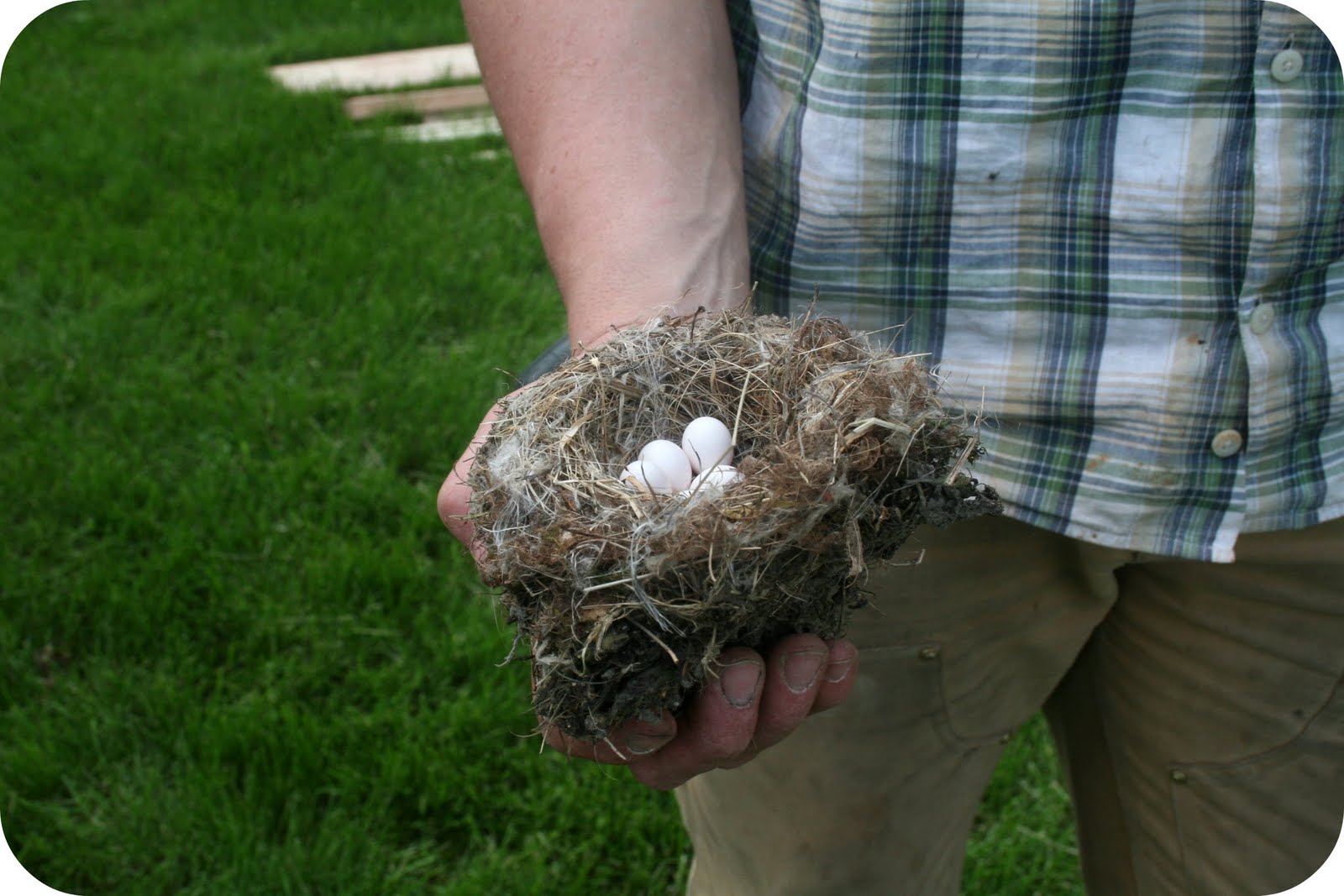
We’re all pretty excited about the chickens moving into their coop. Well, all of us except for mama bird who had a nest full of eggs that we found in the eves of the old-shed-turned-coop. Mama bird swooped and chirped and was downright angry when we moved her precious nest. Hopefully everything is all right with that little family that has been evicted. I’m sure there was a more proper way to do it, but we didn’t touch the eggs and Knut relocated it to the woods where the barn swallow kept a close eye on him. The kids and I got to see the eggs, though, and it’s one of those times when the mystery of nature takes your breath away. God’s creation is a wild and amazing thing, isn’t it? Hopefully the eggs will come to no harm, although we’ll never know. The mother darted into the woods after it, but “they” say she will reject them. One thing this reassures us of is that birds like to lay eggs in this spot and that is just what we are hoping!
Some chicks were spotted sitting on the top edge of the cardboard box that they were staying in, so we knew that the coop needed to be prepped sooner rather than later. We’ve also discovered that 2, possibly 3 of our chickens are actually roosters that were mistakenly given to us by our friend who ordered with us. It’s so hard to tell if chicks are males or females! “Queenie” is actually a “Kingie.” Since both Knut and I feel that we’re not quite ready at this time to add roosters to our flock, we’ll be switching them back with Conrad for 3 of his chickens, as he meant to keep those roosters for his own flock in the first place.
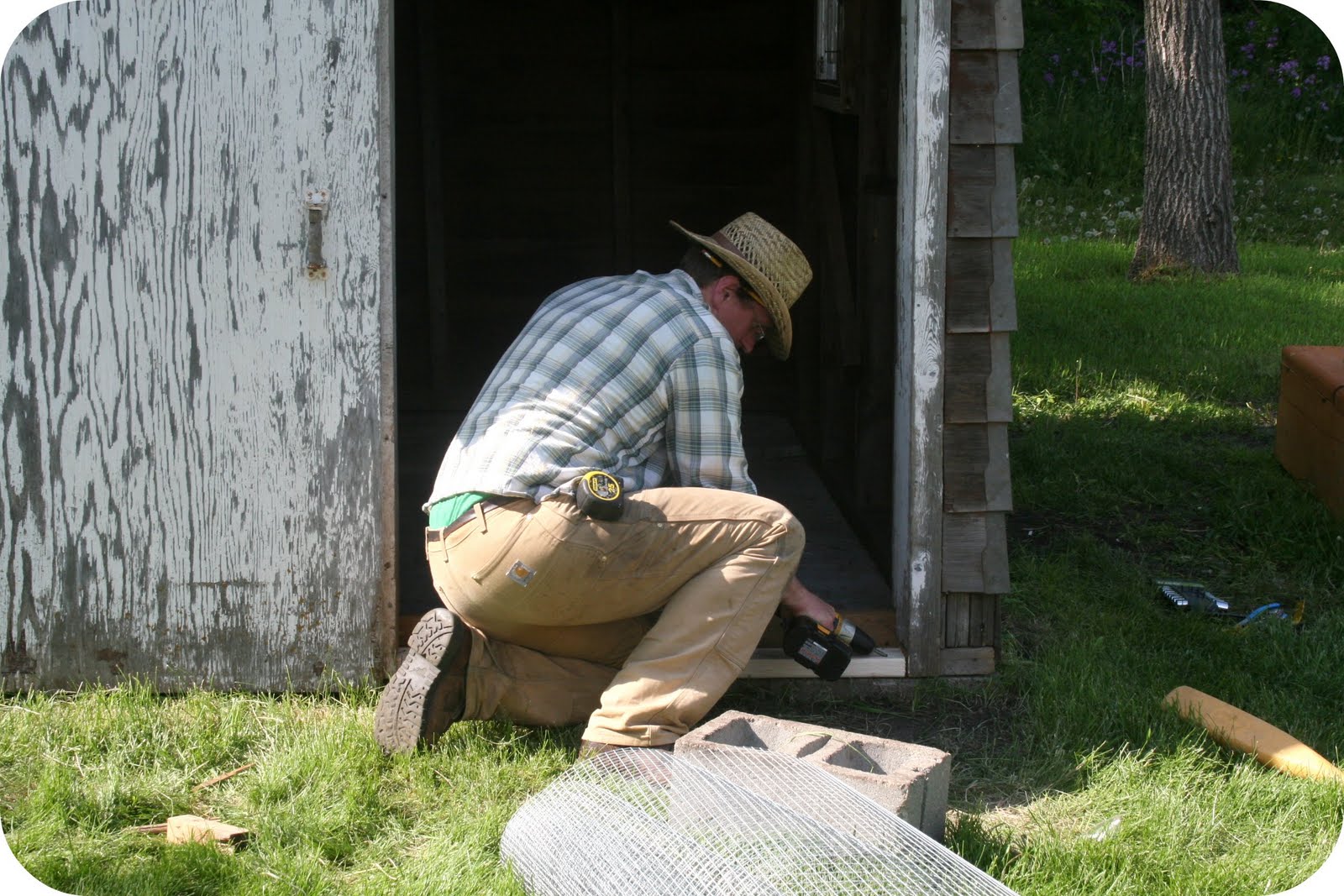
Knut spent all day Saturday working on proper ventilation, installing chicken wire, sealing up holes so varmints couldn’t get in, making sure the door could shut properly,etc. He had a long list. There were several times when he wanted to throw up his hands and say it would be easier to start from scratch. I went out to check on him once, and he shook his head and said the chickens wouldn’t last a week in there. There were simply too many holes to fill. I asked if the holes posed a danger of predators or drafts, so we could deal with each one properly. We were told to put up chicken wire that was 1/2″ or 3/4″ to keep out pests. Therefore, with that logic, pests couldn’t get in a spot that was less than an inch. So we went around measuring holes, and there were a few spaces between the boards that went up to an inch, but most were just cracks.
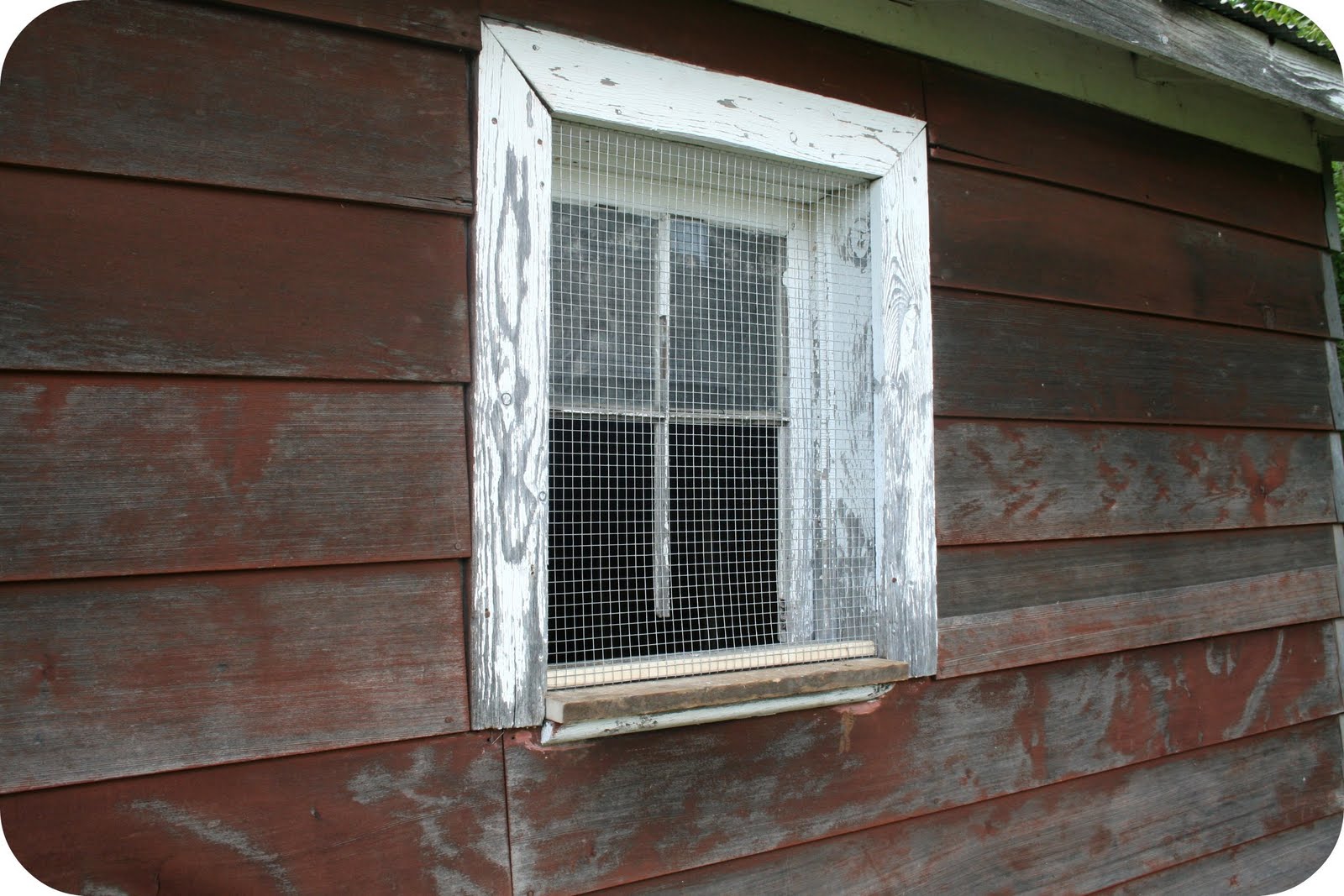
So he nailed up some more boards in some places, and put mortar against the crack-y cement slab in other places. He did a way nicer job to installing the chicken wire over the windows than I would have done. He’s a perfectionist at heart, and it was driving him mad that this was a really old shed that was never going to look totally perfect. I tried to encourage him that it’s for chickens…not his grandma.
While he took a quick break to play with the kids, I took an old broom and swept the ceiling and walls of all of the cobwebs, and gave the cement floor a good sweep too. It looked so great after that! Our guide, Keeping Chickens
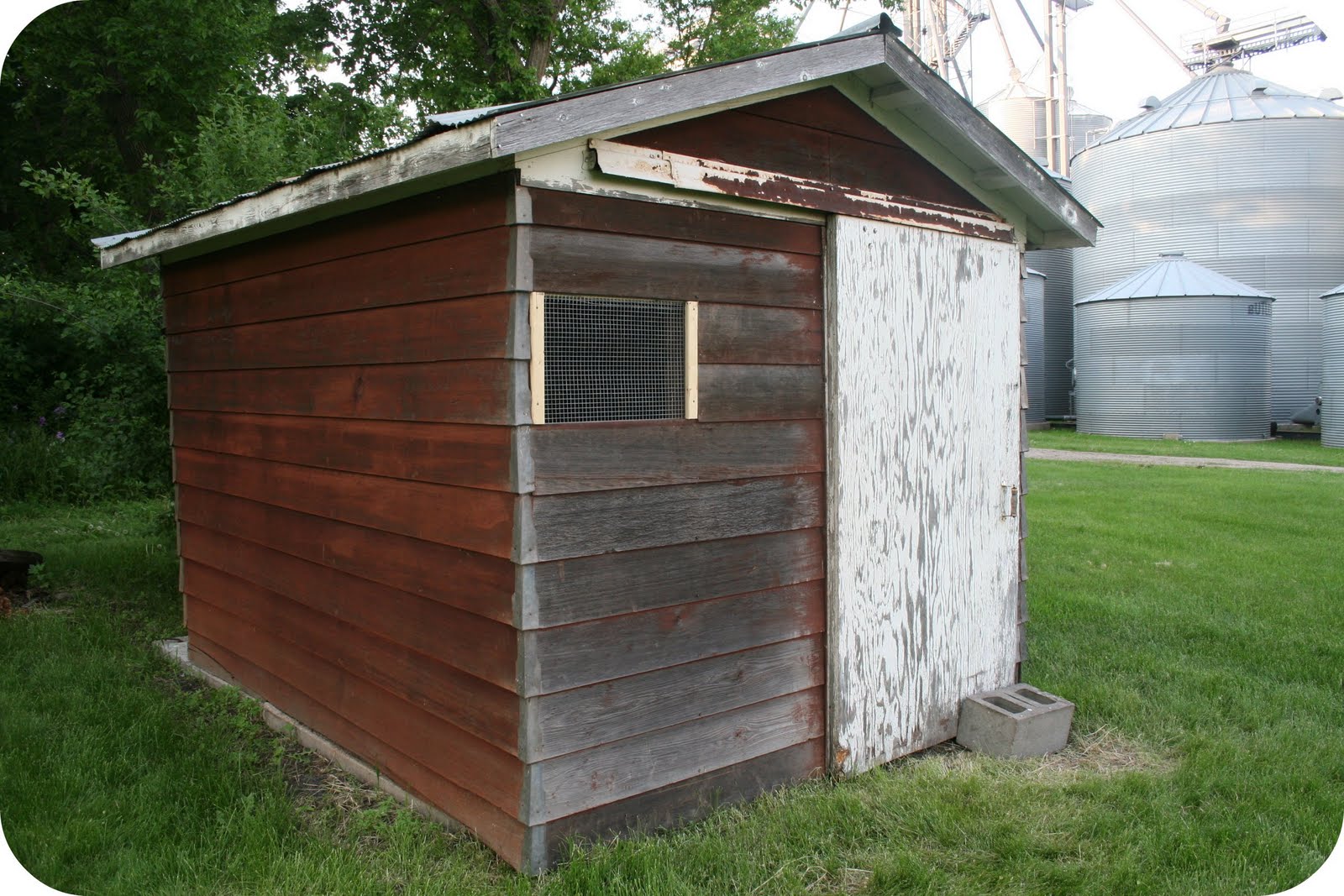
In the end, I think Knut was pleased, and I definitely was! He still has a bit of work to do on the roof, and we’ll need to get it winterized sometime before he starts harvest. In my mind, this involves putting boards over some of the wire, and something will have to be done with the window that’s missing some panes. We’ll also have to get some nesting boxes in there by the time they fully mature. We’ve been planning to either build some, or just buy some and be done with it. Knut pulled out an old metal cabinet that had been rusting in there when he was cleaning the shed out, and I asked if it would work for a nesting box. His eyes lit up at the thought of just leaving it and not having to worry about getting nesting boxes, but after we measured it we realized that the permanent shelving in it was too close together for the birds to comfortably nest. Our books suggests about 12″ head space, and the shelves in there were 8″. The idea, though, has our minds reeling for something lying around here that we could recycle in there as nesting boxes and not have to build or buy them.
We were planning on adding several branches or sticks for perches, and I had an idea to tilt an old wooden ladder I picked up at a garage sale for $2 against the wall for extra perches. Then I saw on some chicken website someone who put a wooden ladder horizontally over cinder blocks for even more perching space than just leaning against the wall. Since that has us covered and is super easy, that’s what we set up for now, and are foregoing the sticks and dowels attached to the wall.
We’re not fully agreed as to whether or not we need insulation for the coop for winter. I don’t think we need it, and he thinks we may. Mostly because all of the chicken keepers around here I’ve talked to say you don’t need it, and all of the people he’s talked to say you do. According to our book, you don’t need it, but you do need to provide extra food in the winter if you don’t. If you do insulate, you need to take even more measures (aka more money) to make sure you’re getting proper air ventilation to the chickens as they are very prone to respiratory disease. We’ll need good air in there especially since they’ll be so many chickens in there. Our book says 4-10 square feet per chicken in the coop. We have exactly 20 chickens and exactly 80 square feet to our coop. So we’re basically at our fullest capacity, unless some of our chickens have an untimely meeting with an eagle or some other predator this summer.
Knut spent a good amount of time looking online, and found that many chicken owners are divided on this issue as well. One lady in Alaska said she absolutely doesn’t insulate her coop, and wouldn’t think of it because of the air quality problems with ventilation that you can have without fresh air, and others say that your egg production is better and you don’t need to use as much food if you do.
At least one thing that is in my favor, as I’m against insulating The chickens need to move in this week, and Knut has a to-do list too long already and he’s not too eager to add to it. The lack of time may settle the matter.
 Anonymous says
June 7, 2011 at 8:51 pmYou are really taking this chicken business seriously!!! We had 5 hens and a rooster given to us last year and used an old barn stall to as their coop. We put up chicken wire too to keep varmits out, but lost our 6 to our inability to be home by dusk every day to close up the coop again. We have lots of foxes around (that are now hunting in full sunlight too -brave huh?) that ended up killing all of ours. Our neighbors recently had the same trouble…came home late from a kid’s ballgame (7pm ish) and the fox had already dones its damage!
I was going to tell you that the nexting boxes don’t have to be much! We ended up making a perch in the corners with a 10” wide board, and then placed a few spare milk crates turned sideways on top. The chickens happily made their nests in the crates and even sometimes nested in the corner on the floor.
We did not winterize…and we had them from January through May in Illinois…lots of snow and ice during that time. We did however, provide lots of straw to bed and also hung a single (shielded) light bulb that hung just above the waterer. It kept the waterer from freezing and also provided some warmth if the chickens felt terribly cold. We never had any complaints : )
We let ours roam free most days, but when we left them in the coop, we would toss our table or cooking scraps in with them. They will eat just about anything!
Good luck!
Teresa